 Official websites use .gov
A .gov website belongs to an official government organization in the United States.
 Secure .gov websites use HTTPS
A lock (Lock A locked padlock) or https:// means you’ve safely connected to the .gov website. Share sensitive information only on official, secure websites.
Stormwater Discharges from Municipal Sources
- OVERVIEW
- Developing an MS4 Program
- Resources
Recent Developments * Stormwater Resources Added to Long-Term Stormwater Planning/Integrated Planning * (1.06 MB) * Final Phase II Rule Clarification Related to Census Bureau Urban Area Designation Criteria * Off-Site Stormwater Management * (2.71 MB)
** (1.06 MB) - Overview of outreach materials and funding resources available from EPA. Final Phase II Rule Clarification Related to Census Bureau Urban Area Designation Criteria** - This final rule retains the existing approach in the Phase II regulations for designating small municipal separate storm sewer systems (MS4s) after publication of each decennial census by replacing the term “urbanized area” with “urban areas with a population of at least 50,000,” which is the Census Bureau’s longstanding definition of the term urbanized areas.
Quick links to relevant information on stormwater discharges from municipal sources: * Stormwater Smart Outreach Tools * Community Solutions for Stormwater Management: A Guide for Voluntary Long-Term Planning * Stormwater Discharges from Transportation Sources * National Menu of Best Management Practices (BMPs) for Stormwater * Stormwater Maintenance * Off-Site Stormwater Management
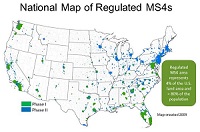 View a larger version of this map
Polluted stormwater runoff is commonly transported through municipal separate storm sewer systems (MS4s), and then often discharged, untreated, into local water bodies.
An MS4 is a conveyance or system of conveyances that is:
* owned by a state, city, town, village, or other public entity that discharges to waters of the U.S.,
* designed or used to collect or convey stormwater (e.g., storm drains, pipes, ditches),
* not a combined sewer, and
* not part of a sewage treatment plant, or publicly owned treatment works (POTW).
View a larger version of this map
Polluted stormwater runoff is commonly transported through municipal separate storm sewer systems (MS4s), and then often discharged, untreated, into local water bodies.
An MS4 is a conveyance or system of conveyances that is:
* owned by a state, city, town, village, or other public entity that discharges to waters of the U.S.,
* designed or used to collect or convey stormwater (e.g., storm drains, pipes, ditches),
* not a combined sewer, and
* not part of a sewage treatment plant, or publicly owned treatment works (POTW).
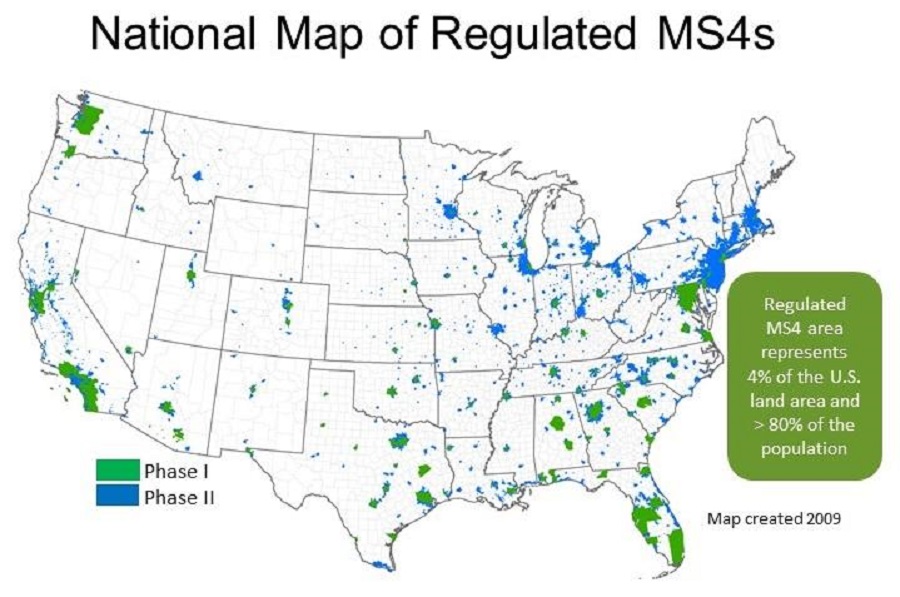
To prevent harmful pollutants from being washed or dumped into MS4s, certain operators are required to obtain NPDES permits and develop stormwater management programs (SWMPs). The SWMP describes the stormwater control practices that will be implemented consistent with permit requirements to minimize the discharge of pollutants from the sewer system.
| Phase I MS4s | Phase II MS4s |
| --- | --- |
| The 1990 Phase I regulation requires medium and large cities or certain counties with populations of 100,000 or more to obtain NPDES permit coverage for their stormwater discharges. There are approximately 855 Phase I MS4s covered by 250 Individual Permits | The 1999 Phase II regulation requires small MS4s in U.S. Census Bureau defined urbanized areas, as well as MS4s designated by the permitting authority, to obtain NPDES permit coverage for their stormwater discharges. Phase II also includes non-traditional MS4s such as public universities, departments of transportation, hospitals and prisons. Most of the 6,695 Phase II MS4s are covered by statewide General Permits, however some states use individual permits. There are three Watershed Permits that cover 3 Phase I and 40 Phase II MS4s. |
National Pollutant Discharge Elimination System (NPDES)
Open Sidenav Menu Close Sidenav Menu Contact Us About NPDES Contact Us About NPDES to ask a question, provide feedback, or report a problem. Last updated on June 6, 2025 Welcome! Please share your feedback on how we can make www.epa.gov work better for you. A red asterisk (*) indicates a required field.
Success
Thank you. Your feedback has been received.
Error
alert message Required Questions - page 1 of 2 question_55203_answer_01 How would you rate your experience on www.epa.gov today? *
0 Stars 1 Star 2 Stars 3 Stars 4 Stars 5 Stars Please explain the reason for your rating. * 400 characters allowed Would you like to take two more minutes to answer more questions to help us improve our services? Yes, keep going → No, only submit these responses Optional questions - page 2 of 2 How would you describe yourself? Business Government employee Scientist Student Other Enter other text Please tell us why you visited www.epa.gov today. 400 characters allowed Did you visit www.epa.gov to accomplish a specific task? If yes, please explain why you were able or unable to accomplish your task. 400 characters allowed How can we make www.epa.gov a more helpful website? 400 characters allowed Submit []: required