 Official websites use .gov
A .gov website belongs to an official government organization in the United States.
 Secure .gov websites use HTTPS
A lock (Lock A locked padlock) or https:// means you’ve safely connected to the .gov website. Share sensitive information only on official, secure websites.
Primary Enforcement Authority for the Underground Injection Control Program
On this page: * What is UIC primary enforcement responsibility (primacy)? * What states, territories, and tribes have primacy? * What is the process for states, territories, and tribes to apply for primacy or implement a substantial program revision? * What are the core elements of a primacy application or program revision? * What states, territories, and tribes are currently in the primacy application or substantial program revision process? * Colorado * What states, territories, and tribes have recently completed the primacy application or substantial program revision process? * Arizona * Texas
What is UIC primary enforcement responsibility (primacy)?
Primary enforcement responsibility, often called primacy, refers to state, territory, or Tribal responsibilities associated with implementing EPA approved UIC programs. A state, territory, or Tribe with UIC primacy, or primary enforcement responsibility, oversees the UIC program in that state, territory, or Tribe.
The Safe Drinking Water Act (SDWA) requires the EPA to develop UIC program requirements that protect underground sources of drinking water (USDWs) from endangerment. The EPA developed UIC program requirements that are designed to be adopted by states, territories, and Tribes.
Primacy programs are established under the SDWA sections 1422 and 1425. Section 1422 applies to all well classes and requires primacy applicants to meet the EPA’s minimum requirements for UIC programs. Section 1425 applies to Class II wells only and requires primacy applicants to demonstrate their standards are effective in preventing endangerment of USDWs.
| | SDWA Section 1422 | SDWA Section 1425 |
| --- | --- | --- |
| Program Requirements | Meets minimum EPA requirements for UIC programs | Demonstrate standards are effective in preventing endangerment of USDWs |
| Demonstrate to the EPA that the state, territory, or Tribe has jurisdiction over underground injection and the necessary administrative, civil and criminal enforcement penalty remedies. |
| Well Class Applicability | · All well classes · Classes I – V · Class VI | Class II |
What states, territories, and Tribes have primacy?
The EPA has approved UIC primacy programs for multiple well classes in thirty-one states and three territories. If a state, territory, or Tribe does not obtain primacy for all or some UIC well classes, the EPA implements the program directly through one of its regional offices. Currently, the EPA implements the UIC program for all well classes in seven states and three territories. Apart from the Navajo Nation and Fort Peck Class II programs, the EPA directly implements the UIC program in Indian country. Use your cursor and hover over the states, tribes and territories (all referred to collectively as “State”) in the map below, or refer directly to the table, for state-specific primacy information.
UIC Primacy Map
Tribes
| | Navajo Nation |
| --- | --- |
| | Fort Peck Tribes |
| | All Other Indian Tribes. |
Key
| | EPA manages all well classes. |
| --- | --- |
| | State has primacy for Class II wells only. |
| | State has primacy for multiple well classes. |
| | State has primacy for all well classes (Classes I, II, III, IV, V and VI). |
Show 10 25 50 All entries
| State | Well Classes | SDWA Reference | Primary Enforcement Responsibility | Responsible Agency |
| --- | --- | --- | --- | --- |
| Alabama | II | 1425 | AL | AL Oil and Gas Board |
| Alabama | I, III, IV,V | 1422 | AL | AL Department of Environmental Management |
| Alabama | VI | 1422 | EPA | Region 4 |
| Alaska | II | 1425 | AK | AK Oil and Gas Conservation Commission |
| Alaska | I,III,IV,V,VI | 1422 | EPA | Region 10 |
| American Samoa | I,II,III,IV,V,VI | 1422 | EPA | Region 9 |
| Arizona | I,II,III,IV,V,VI | 1422 | AZ | AZ Department of Environmental Quality |
| Arkansas | II | 1425 | AR | AR Oil and Gas Commission |
| Arkansas | I, III, IV,V | 1422 | AR | AR Department of Environmental Quality |
| Arkansas | VI | 1422 | EPA | Region 6 |
Showing 1 to 10 of 121 entries
Previous12345…13Next
What is the process for states, territories and tribes to apply for primacy or implement a program revision?
States, territories and tribes applying for UIC program primacy must follow the UIC primacy application process requirements presented at 40 CFR part 145. Two EPA guidance documents describe the general procedures for the Agency's review and approval of primacy and program revision applications. EPA Guidance Download EPA primacy and program revisions regulatory checklist and crosswalk. * Guidance for Review and Approval of State Underground Injection Control Programs and Revisions to Approved State Programs - provides guidance to the EPA regional offices on the process for the approval of state primacy application and the process for approving program revisions for programs approved under both Safe Drinking Water Act (SDWA) Section 1422 and 1425. * Guidance for State Submissions Under Section 1425 of the Safe Drinking Water Act (SDWA) -provides guidance on how states may apply for primacy approval under Section 1425 of the SDWA and the criteria the EPA will use in approving or disapproving an application.
The information provided on this webpage is intended to clarify procedures and facilitate transparency and consistency in primacy and program revision evaluations and approvals.

Phase I: Pre-application Activities
Under this phase, the EPA may support a state, territory, or Tribe by: * Identifying available resources and the critical elements of a primacy application or program revision. * Meeting to outline the process, address preliminary questions, and determine which well classes may be included in the application. * Reviewing the applicants draft UIC statutes and regulations, or any other material in the application package. * Encouraging a comparison with federal regulations using the comparison crosswalk template.
Phase II: Application Evaluation and Completeness Determination
Under this phase, the EPA and the state, territory, or Tribe conducts the following activities: * EPA receives and reviews complete or mostly complete drafts of applicable critical elements of the primacy application. * Evaluates each primacy application element and coordinates with applicants to clarify questions and confirm stringency or effectiveness. * EPA and a state, territory, or Tribe may engage in a continued dialogue to clarify questions. * A state, territory or Tribe may identify regulatory or statutory changes to implement by the end of this phase. * The EPA’s regional UIC program verifies the application is complete and transmits it to the National UIC program to initiate rulemaking.
Phase III: Proposed Rulemaking
Under this phase, the EPA conducts the following activities: * Publishes a proposed rule signed by the EPA Administrator which indicates the EPA’s intent to approve or disapprove of a primacy application or program revision. * Initiates a minimum 45-day public comment period and holds a public hearing, if requested. * The EPA may request additional information and/or coordinate with applicants to confirm stringency or effectiveness.
Phase IV: Final Rulemaking and Codification
Under this phase, the EPA conducts the following activities: * Reviews all public comments provided through the EPA docket and the public hearing. * Depending on the comments, the EPA may request additional information and/or coordinate with applicants to confirm stringency or effectiveness. * Drafts the final rule approving, or disapproving, the primacy application or program revision. * Prepares the final rule package for submission to the EPA Administrator. The final rule package includes: a summary of the public comments and the EPA’s responses; documentation of any changes from the state’s original application and the EPA’s rationale for finalizing the rule with such changes; and the regulatory text that will be codified in 40 CFR part 147 after the program is approved. * The EPA Administrator signs the final rule for publication in the federal register.
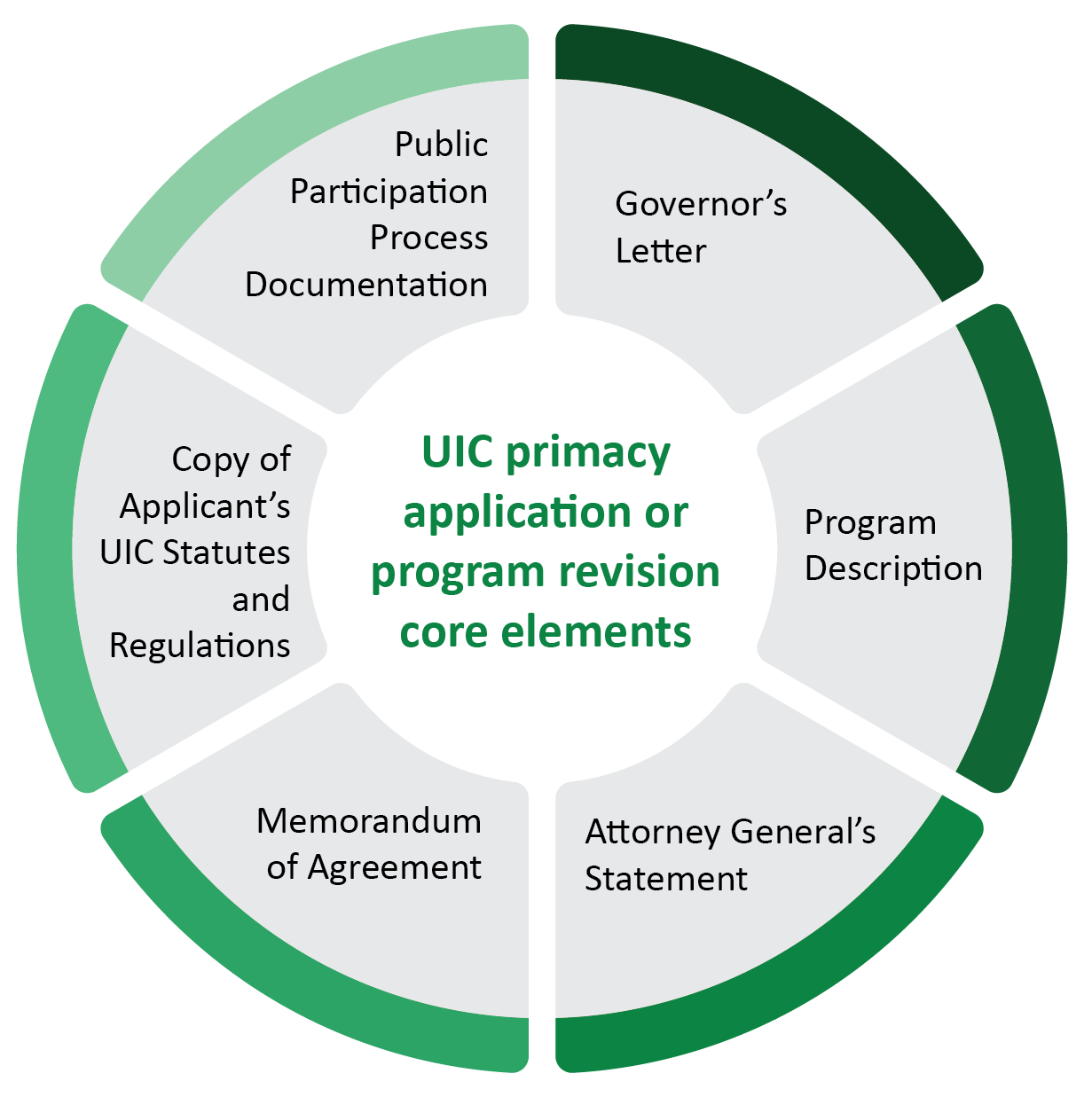
What are the core elements of a primacy application or program revision?
 Click to Enlarge
UIC Program regulations at 40 CFR part 145 identify six core elements of a UIC primacy application or substantial program revision.
Each of the six requirements are identified below. All documents are required for a new primacy application. For program revisions, depending on the nature of the UIC program changes, a state, territory, or tribe may need to revise one or more of the six core elements and submit a revised primacy application to the EPA.
Click to Enlarge
UIC Program regulations at 40 CFR part 145 identify six core elements of a UIC primacy application or substantial program revision.
Each of the six requirements are identified below. All documents are required for a new primacy application. For program revisions, depending on the nature of the UIC program changes, a state, territory, or tribe may need to revise one or more of the six core elements and submit a revised primacy application to the EPA.
| Governor's Letter | Program Description | Attorney General's Statement | Memorandum of Agreement | Copy of Applicant's UIC Statutes and Regulations | Public Participation Process Determination |
| --- | --- | --- | --- | --- | --- |
|
* A signed letter from the governor of the state requesting approval for UIC program primacy.
* Must specify that approval is sought under sections 1422 or 1425 of the SDWA.
| * A document describing in narrative form the scope, structure, coverage and processes of the applicant’s program.
| * A certification by a qualified representative of the state, asserting that the state’s statutes, regulations and judicial decisions demonstrate adequate authority to administer the UIC program.
| * The central agreement setting out the provisions and arrangements between the applicant and the EPA. * Describes the administration, implementation and enforcement of the applicant’s UIC program.
| * A copy of the applicable UIC statutes and regulations. * SDWA Section 1422: Applicants may incorporate the federal regulations by reference, adopt the federal language verbatim, or establish final provisions that are as stringent as the federal requirements. * SDWA Section 1425: Applicants must demonstrate that their Class II regulations are effective in preventing underground injection that endangers USDWs.
| * Documentation of the public participation process the applicant used to notify the public of its intent to apply for primacy.
|
| Review an example letter from a recently approved program.Exit EPA’s website | Review and example from a recently approved program. | Review and example from a recently approved program. | Review an example from aExit EPA’s website recently approved program.Exit EPA’s website | Review an example from a recently approved program.Exit EPA’s website | Review an example from a recently approved program.Exit EPA’s website |
What states, territories, and tribes are currently in the primacy application or program revision process?
Status of state, territory, and tribal primacy and program revision applications
 Note that states, territories, and/or tribes in Phase IV include those undergoing final rulemaking and codification, as well as those that have received a final primacy determination within the past year.
Colorado
Summary of Action
On March 16, 2026, the U.S. Environmental Protection Agency’s Administrator Lee Zeldin signed the Proposed Rule to approve the State of Colorado’s request for primary enforcement responsibility of Class VI wells under the UIC program. After conducting a comprehensive review of the application, EPA is proposing to approve Colorado’s primacy application because EPA has determined, subject to public comment, that the application meets all applicable requirements for primacy approval under the Safe Drinking Water Act section 1422. If granted primary enforcement responsibility, this will allow the Colorado Energy and Carbon Management Commission to authorize injection for Class VI wells and ensure compliance with UIC program requirements. The public comment period for the Proposed Rule ended on May 4, 2026, and a virtual public hearing was held on Thursday, April 23, 2026. Review the Proposed Rule documenting the Agency's action. Exit EPA’s website
What states, territories, and tribes have recently completed the primacy application or program revision process?
Note that states, territories, and/or tribes are removed from this section one year after final primacy determination. Please see the map above for all states, territories, and/or tribes that have primacy.
Arizona
Summary of Action
On September 10, 2025, the U.S. Environmental Protection Agency announced the final ruleExit EPA’s website approving the State of Arizona’s request for primary enforcement responsibility of Class I-VI wells under the UIC program, except on Indian lands. On February 13, 2024, the State of Arizona submitted to the EPA a primary enforcement authority application packageExit EPA’s website under the Safe Drinking Water Act (SDWA) section 1422. On May 19, 2025, the EPA published a Proposed Rule in the Federal RegisterExit EPA’s website for public input. The public comment period for the Proposed Rule ended on July 3, 2025, and a virtual public hearing was held on June 25, 2025. After conducting a comprehensive review and considering public comment, the EPA is approving Arizona’s primacy application because the EPA has determined that the application meets all applicable requirements for primacy approval under the SDWA 1422. Review the EPA's responsiveness summary to public comments.
Texas
Summary of Action
On November 7, 2025, the U.S. Environmental Protection Agency's Administrator Lee Zeldin signed the final ruleExit EPA’s website to approve the State of Texas’ request for primary enforcement responsibility of Class VI wells under its current UIC program. On February 20, 2025, Texas submitted to the EPA a program revision applicationExit EPA’s website to add Class VI wells to the State's SDWA section 1422 UIC program. On June 17, 2025, the EPA published a Proposed Rule in the Federal Register for public input. The public comment period for the Proposed Rule ended on August 1, 2025, and a virtual public hearing was held on July 24, 2025. After conducting a comprehensive review and considering public comment, the EPA is approving Texas’ primacy application because the EPA has determined that the application meets all applicable requirements for primacy approval under the SDWA 1422. Review the EPA's responsiveness summary to public comments. Contact Us About Underground Injection Control to ask a question, provide feedback, or report a problem. Last updated on May 6, 2026 Welcome! Please share your feedback on how we can make www.epa.gov work better for you. A red asterisk (*) indicates a required field.
Success
Thank you. Your feedback has been received.
Error
alert message Required Questions - page 1 of 2 question_55203_answer_01 How would you rate your experience on www.epa.gov today? *
0 Stars 1 Star 2 Stars 3 Stars 4 Stars 5 Stars Please explain the reason for your rating. * 400 characters allowed Would you like to take two more minutes to answer more questions to help us improve our services? Yes, keep going → No, only submit these responses Optional questions - page 2 of 2 How would you describe yourself? Business Government employee Scientist Student Other Enter other text Please tell us why you visited www.epa.gov today. 400 characters allowed Did you visit www.epa.gov to accomplish a specific task? If yes, please explain why you were able or unable to accomplish your task. 400 characters allowed How can we make www.epa.gov a more helpful website? 400 characters allowed Submit []: required