 Official websites use .gov
A .gov website belongs to an official government organization in the United States.
 Secure .gov websites use HTTPS
A lock (Lock A locked padlock) or https:// means you’ve safely connected to the .gov website. Share sensitive information only on official, secure websites.
Copper Forming Effluent Guidelines
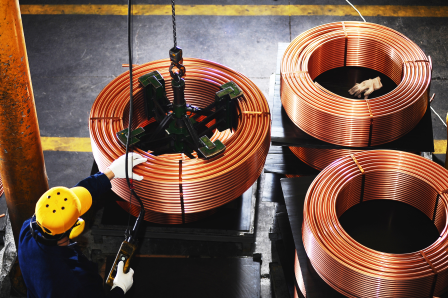 The EPA promulgated the Copper Forming Effluent Guidelines and Standards (40 CFR Part 468Exit EPA’s website) in 1983 and amended the regulation in 1986. The regulation covers directdirectA point source that discharges pollutants to waters of the United States, such as streams, lakes, or oceans. and indirectindirectA facility that discharges pollutants to a publicly owned treatment works (municipal sewage treatment plant). dischargers. The Effluent Guidelines and Standards are incorporated into NPDES permits for direct dischargers, and permits or other control mechanisms for indirect dischargers (see Pretreatment Program).
On this page:
* What is the Copper Forming Industry?
* Wastestreams, Regulated Pollutants, and Facilities Covered
* Related Categories
* Guidance Documents
* Rulemaking History
* Additional Information
The EPA promulgated the Copper Forming Effluent Guidelines and Standards (40 CFR Part 468Exit EPA’s website) in 1983 and amended the regulation in 1986. The regulation covers directdirectA point source that discharges pollutants to waters of the United States, such as streams, lakes, or oceans. and indirectindirectA facility that discharges pollutants to a publicly owned treatment works (municipal sewage treatment plant). dischargers. The Effluent Guidelines and Standards are incorporated into NPDES permits for direct dischargers, and permits or other control mechanisms for indirect dischargers (see Pretreatment Program).
On this page:
* What is the Copper Forming Industry?
* Wastestreams, Regulated Pollutants, and Facilities Covered
* Related Categories
* Guidance Documents
* Rulemaking History
* Additional Information
What is the Copper Forming Industry?
Copper forming plants roll, draw, extrude, and forge copper and copper alloys. In addition to these forming operations, there are surface cleaning and heat treatment processes which impart desired surface and physical properties to the metal. For the purposes of this regulation, copper alloys include any alloy in which copper is the major constituent. Principal alloys processed by copper formers include brass, bronze, leaded brass, leaded bronze, nickel silvers, phosphor bronze, aluminum bronze, silicon bronze, beryllium copper, and cupronickel. At the time of the 1983 rulemaking there were approximately 176 copper forming facilities in the United States.
Products
- Plate is a wide rigid piece of metal usually greater than ¼ inch thick. Printing plates were often made from copper, as are plate heat exchangers and some chemical processing vessels.
- Sheet is a wide piece of metal having little rigidity and usually less than ¼ inch thick.
- With strip , the length is many times the width and the product is commonly handled as coils of metal called coiled strip. Its uses include roof gutters, gaskets, radio parts, trim, weather strip, washers, diaphragms, etc.
- Wire is usually circular in cross section and is flexible. Wire that is twisted or woven into strands, used for lifting or in structural supports, is known as cable.
- Rod is similar to wire in that it has a circular cross section but is more rigid. Rod and wire are used for screening, fasteners, jewelry, cotter pins, lock washers, springs, truss wire, wire brushes, welding rods, chains, hooks, and electrical conductors.
- Tubing is material in the form of long hollow cylinders. In general, tubing is used for transporting fluids and heat transfer applications. Specifically, it is used for gas lines; heater lines; oil burner tubes; plumbing pipe and tube; refrigerators; condensers; evaporators; heat-exchanger tubes; dairy tubes, and hydraulic lines.
- Forgings are formed from copper, usually hot, by individual and intermittent applications of pressure. Forging may be done in open or closed dies. These pieces generally have more intricate shapes than other types of formed copper products.
Copper forming activities are included within the following NAICS groups: * 331421: Copper Rolling, Drawing, and Extruding * 331422: Copper Wire (except Mechanical) Drawing
Note: the NAICS listing is provided as a guide and does not define the coverage of the Copper Forming category. For precise definitions of coverage, see the applicability sections in 40 CFR Part 468Exit EPA’s website.
Manufacturing Techniques
- Hot rolling
- Cold rolling
- Extrusion
- Drawing
- Forging
-
Surface and heat treatment processes:
- Annealing
- Pickling
- Alkaline cleaning
- Solution heat treatment (quenching)
-
Additional operations at some plants:
- Tumbling or burnishing
- Surface coating
- Hydrostatic testing
- Sawing
- Surface milling
Wastestreams, Regulated Pollutants, and Facilities Covered
Wastestreams
- Lubricants used in the forming processes
- Solution heat treatment (cooling water)
- Alkaline cleaning bath and rinse
- Annealing (cooling water)
-
Pickling bath and rinse
-
Pickling fume scrubber
- Tumbling or burnishing (lubricant)
- Surface coating
- Miscellaneous
Regulated Pollutants
The regulated parameters vary by subcategory, and include: * chromium * copper * lead * nickel * zinc
- toxic organic compounds
- suspended solids
- pH (abnormally high or low)
- oil and grease
Facilities Covered
Related Information * Stormwater fact sheet (Sector F)
- Manufacture of formed copper and copper alloy products
- Excluded:
- Forming of beryllium copper alloys (any copper alloy that is alloyed to contain 0.10 percent or greater beryllium)
- Forming of precious metals (any alloy containing 30 or greater percent by weight of precious metals is considered a precious metal)
- Casting of copper and copper alloys
- Copper powders
Related Categories
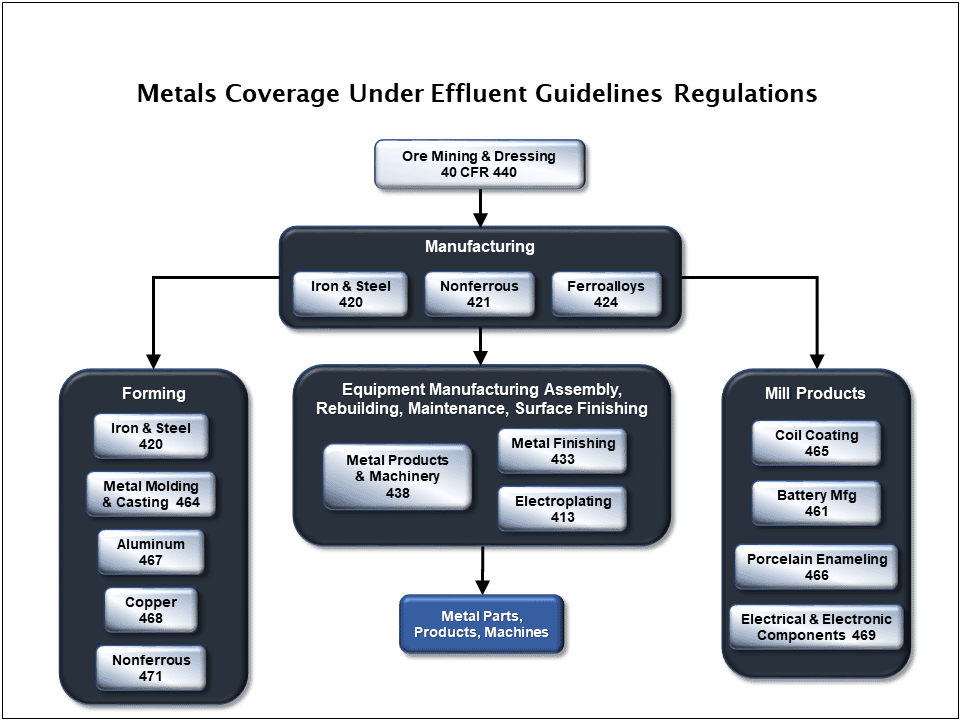 Metals coverage under Effluent Guidelines
- Click to enlarge
* Casting is regulated under the Metal Molding and Casting (Foundries) Category (40 CFR Part 464Exit EPA’s website).
* The manufacture of copper powders and the forming of parts from copper or copper alloy powders is regulated under the Nonferrous Metals Forming and Metal Powders Category (40 CFR Part 471Exit EPA’s website).
* Metal Finishing (40 CFR Part 433Exit EPA’s website)
* Metal Products and Machinery (40 CFR Part 438Exit EPA’s website)
Guidance Documents
- Aluminum, Copper, and Nonferrous Metals Forming and Metal Powders Pretreatment Standards: A Guidance Manual (December 1989)
Guidance to publicly owned treatment works (POTWs) on the implementation and enforcement of categorical pretreatment standards - Guidance Manual for Implementing Total Toxic Organics (TTO) Pretreatment Standards (September 1985)
Rulemaking History
1986 Amendment
Excluded the forming of beryllium copper alloys from the requirements in the 1983 rule; promulgated pursuant to litigation. * Final Rule (March 5, 1986)
1983 Initial Rulemaking
- Documents, including:
- Final Rule (August 15, 1983)
- Development Document (March 1984)
Industry description, wastewater characterization, treatment technologies, regulatory compliance cost estimates and pollutant loadings for the final rule - Proposed Rule (November 12, 1982)
Additional Information
For additional information regarding Copper Forming Effluent Guidelines, please contact Samantha Lewis (lewis.samantha@epa.gov) or 202-566-1058.
Effluent Guidelines
Open Sidenav Menu Close Sidenav Menu Contact Us About Effluent Guidelines Contact Us About Effluent Guidelines to ask a question, provide feedback, or report a problem. Last updated on May 31, 2025 Welcome! Please share your feedback on how we can make www.epa.gov work better for you. A red asterisk (*) indicates a required field.
Success
Thank you. Your feedback has been received.
Error
alert message Required Questions - page 1 of 2 question_55203_answer_01 How would you rate your experience on www.epa.gov today? *
0 Stars 1 Star 2 Stars 3 Stars 4 Stars 5 Stars Please explain the reason for your rating. * 400 characters allowed Would you like to take two more minutes to answer more questions to help us improve our services? Yes, keep going → No, only submit these responses Optional questions - page 2 of 2 How would you describe yourself? Business Government employee Scientist Student Other Enter other text Please tell us why you visited www.epa.gov today. 400 characters allowed Did you visit www.epa.gov to accomplish a specific task? If yes, please explain why you were able or unable to accomplish your task. 400 characters allowed How can we make www.epa.gov a more helpful website? 400 characters allowed Submit [NAICS]: North American Industrial Classification System [*]: required